Showing posts with label Award-PEN. Show all posts

Thursday, October 13, 2016

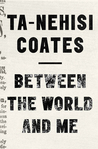
Between the World and Me by Ta-Nehisi Coates

Between the World and MeBetween the World and Me by Ta-Nehisi Coates
My rating: 5 of 5 stars

Excellent memoir (in the form of a letter to the author's son). Strongly recommend every American read this as soon as possible. Coates writes prose as if it is poetry. He clearly and simply traces the relationship between American economics, slavery, the Civil War, the modern South, police brutality, city projects, and the uphill battle of those trying to move away from the history. He manages to pack a lot into a very short book. Between his beautiful writing and his economy of words, I wasn't able to put the book down until I was finished.

It's particularly interesting reading this book right now, when the current presidential election is mired in these very issues. The thing that's different now, is that the racist-sexist forces in our country have failed to hide their intentions this time. With their true intentions on display a majority of the "other" seem to have banded together: Women, black people, Hispanic people, GLBT, and others voting together en masse against the typical oppressors. As Gloria Steinem says racism and sexism are closely related and intertwined. It keeps the maximum number oppressed and also helps keep everyone divided. It's not a conspiracy, it's simply that authoritarians want to keep as much power for themselves and away from as many others as possible, so everyone is "lesser." One thing that Coates stresses though is that even if a majority are moving away from racist-sexist attitudes, it takes only one act of state-sanctioned terrorism by the police to take away all security. And sadly there have been many more than one.

View all my reviews

Sunday, August 28, 2016

Interpreter of Maladies by Jhumpa Lahiri

Interpreter of MaladiesInterpreter of Maladies by Jhumpa Lahiri
My rating: 4 of 5 stars

I know this is a the Pulitzer Prize fiction winner for 2000, but let's pretend for a moment that I don't know that. I think this was a solid collection, but not quite up to 5 stars.

I think the short stories "A Temporary Matter" and "This Blessed House," which were both short stories about married couples were my favorite. I would have enjoyed reading more about either couple in a full-length novel, which is maybe more of a complaint than praise when it comes to short stories.

I also really liked "The Treatment of Bibi Haldar," which was a little messed up if you take a feminist reading of it, but real life isn't always very feminist either.

View all my reviews

Saturday, August 20, 2016

The Sixth Extinction by Elizabeth Kolbert

The Sixth Extinction: An Unnatural HistoryThe Sixth Extinction: An Unnatural History by Elizabeth Kolbert
My rating: 4 of 5 stars

While I'm pretty clear on the ongoing sixth extinction and am totally horrified by it, one thing that irked me the whole time was wondering what the other five extinctions were. Though she covered some of the others in the book as well, since nothing was in chronological order, I felt a little confused at the end. So here they are:

1. Cretaceous–Paleogene extinction event. About 75% of all species became extinct. In the seas all the ammonites, plesiosaurs, and mosasaurs disappeared. Kolbert talks at length about the ammonites. All non-avian dinosaurs became extinct during that time. This is the one that was probably caused by a huge asteroid hitting the earth. Kolbert talks about the asteroid idea in an earlier chapter than the ammonite chapter which is confusing.

2. Triassic–Jurassic extinction event (End Triassic): About 70% to 75% of all species became extinct.
It was between the Triassic and Jurassic, but I don't really understand this one, and scientists don't really know what caused it.

3. Permian–Triassic extinction event (End Permian): Earth's largest extinction killed about 96% of all marine species and an estimated 70% of land species, including insects. It's called the "Great Dying" and apparently it ended the primacy of mammal-like reptiles? Not sure what those were? Furry reptiles that took care of their young? Scientists also don't know what caused it, but possibly a climate change event.

4. Late Devonian extinction: A prolonged series of extinctions eliminated about 70% of all species. This extinction event lasted maybe 20 million years, with a series of "extinction pulses." Maybe because of more climate change?

5. Ordovician–Silurian extinction events which occurred 443.8 million years ago. Two events occurred that killed off 60% to 70% of all species. Together they are ranked by many scientists as the second largest of the five major extinctions in Earth's history in terms of percentage of genera that became extinct. Not sure what caused this one either. Possibly a combination of climate changes including some freezing.

6. Holocene- 10,000 BCE — now, not even sure yet how many species have been killed off. Caused by humans. Kolbert discusses the American mastodon, Auk, rainforest frogs, coral, bats worldwide, and some other species.

These extinctions are especially terrifying because we're destroying entire areas, changing the climate, destroying food chains, spreading weird diseases. Attempts to stop the damage have largely failed so far. Even if we manage to survive what we're doing the earth might be a really bad place to live for a long time. So... not exactly beac reading.

View all my reviews

Sunday, June 12, 2016

The Emperor of All Maladies by Siddhartha Mukherjee

The Emperor of All Maladies: A Biography of CancerThe Emperor of All Maladies: A Biography of Cancer by Siddhartha Mukherjee
My rating: 5 of 5 stars

This book is amazing. It's informative: even with all I know about cancer (unfortunately) I still learned so much. It's interesting: I was eager to go back to this long book and learn more about the disease and the people who changed the landscape of the battle against cancer. I was afraid to read it because I thought I would find it horribly depressing (especially after reading Being Mortal by Atul Gawande) but it wasn't. It was hopeful in a practical realistic way, explaining what is being done currently all that remains to be done.

My only critique is that the book rambled on at the end quite a bit. It should have had a shorter tighter ending. The ending seems to have dragged on from Chapters 46-49, and an epilogue.

View all my reviews
Related Posts Plugin for WordPress, Blogger...